

In aviation, there is a phenomenon known as spatial disorientation. It occurs when a pilot loses visual reference to the horizon, often while flying through dense cloud. The inner ear begins to lie; the senses conflict with the instruments. In that moment, survival depends on suppressing instinct and trusting the data.
Modern society is experiencing a collective form of spatial disorientation.
We are currently navigating a thick, synthetic fog generated by what I call the “Program Box”—the old television “box” reborn in digital form. While its ostensible purpose is to deliver entertainment and news “programs,” its deeper function is to program the observer. To regain clarity, one must ascend above this manufactured turbulence, climbing to an altitude where the static falls away and the hidden contours of the terrain finally become visible.
This column is an invitation to make that ascent.
Yet perspective requires more than altitude alone. While the 60,000-foot view is essential for strategic clarity—revealing the “Grand Chessboard”—we cannot occupy that thin air indefinitely. It is a vantage point for insight, though impractical for daily survival. Eventually, one must descend and engage with the terrain below. Both perspectives matter. This column will oscillate between them.
Learning to Read the Terrain
My journey toward this perspective began decades ago. As a septuagenarian whose life has traversed multiple professions, cultures, and continents, I eventually found myself applying to the larger structures shaping society the same analytical rigor I once applied as an aeronautical engineer who designed, built, and flight-tested experimental aircraft. And when I did, certain seams in the official narrative began to reveal themselves.
We have become conditioned to accept the term “Elites”—a vague label used to describe billionaires, political dynasties, corporate titans, and public figureheads. In reality, many are little more than visible functionaries. Behind them exists a far more entrenched layer of influence: a transnational financial power existing largely beyond public scrutiny and beyond the reach of electoral politics—answerable not to nations or peoples, but only to its own continuity and expansion.
History proves—at least to those willing to examine it objectively—that those who control the issuance of currency and the flow of debt eventually acquire influence over governments themselves. From central banking systems to multinational financial institutions, the relationship between money and power has consistently shaped the trajectory of nations. This is hardly new; it is woven throughout recorded history.
Over time, I also began to recognize another recurring pattern: the management of narrative during moments of major geopolitical transition. Wars, crises, economic collapses, and societal shocks often serve as catalysts for sweeping structural change. Whether one examines the Gulf of Tonkin, the weapons-of-mass-destruction narrative surrounding Iraq, the events of 9/11, or, more recently, the provocations surrounding Iran, one repeatedly encounters the uneasy relationship between public perception and political objective.
The Navigators
This realization led me toward the work of several individuals who profoundly shaped my thinking.
Among them was the late Lt. Col. Dr. Robert Bowman. A decorated fighter pilot who flew over 100 combat missions in Vietnam, he also held dual doctorates from Caltech in Aeronautics and Nuclear Engineering. As the former head of the Strategic Defense Initiative—better known as “Star Wars”—under Reagan, Bowman understood the machinery of state power and the courage required to challenge it publicly. Years later, when Bob sought the Reform Party nomination for President of the United States in 2004, he asked me to serve as his aide-de-camp. It was a daunting assignment. The Los Angeles Times had once described him as the “greatest orator in America,” and it fell to me to set the stage and introduce him at campaign events. More than a mentor, he became a beloved father figure who taught me far more than the power of the spoken word. He also played a profound role in shaping my understanding of the unresolved contradictions surrounding 9/11.
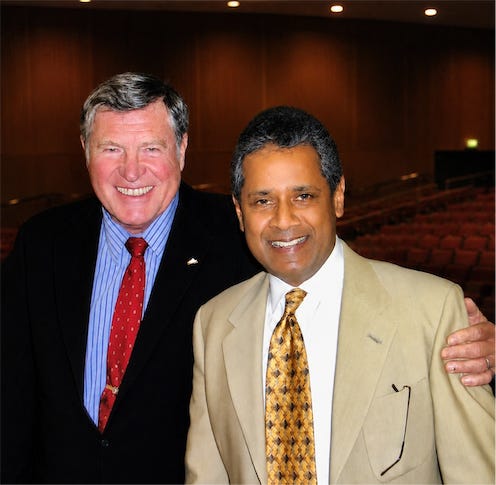
With Dr. Robert M. Bowman, former Director of the U.S. Air Force’s Advanced Space Programs Development and of President Ronald Reagan’s Strategic Defense Initiative (“Star Wars”), during his 2004 presidential campaign. Tallahassee, Florida
I was equally influenced by two dear friends, both now gone: William Blum, the former U.S. State Department insider whose bestselling Rogue State became a global touchstone for critics of modern American empire; and Jim Marrs, the bestselling investigative journalist whose fearless explorations of covert power structures challenged readers to question how history is framed, packaged, and presented to the public. Marrs’ landmark work, Crossfire: The Plot That Killed Kennedy, later served as the principal blueprint for Oliver Stone’s acclaimed film JFK.
From such voices, I gradually came to understand the role played by what I call Narrative Proxies: media figures, “experts,” institutions, and cultural gatekeepers tasked with amplifying “approved” frameworks while marginalizing dissenting interpretations. Their function extends far beyond narrowing the bounds of acceptable inquiry. Often operating as little more than unknowing script-readers, they participate in the manufacture—and, at times, the outright fabrication—of reality itself.
That manipulation is becoming increasingly visible in our own era.
Signals Through the Fog
Recent years have accelerated trends already underway: expanded surveillance, digital identification systems, mandated “vaccinations,” centralized financial technologies such as CBDCs, increasing censorship, and growing efforts to regulate movement, speech, and energy consumption. Whether viewed as necessary governance or—as I do—as something far more troubling, the trajectory is difficult to ignore.
To me, these shifts point toward an even more disturbing transformation—one in which advanced bio-technological and nanotechnological systems increasingly mediate the relationship between the individual and the State.
This is where the “high-altitude” view becomes essential.
When examined in isolation, each development appears manageable, even rational. Viewed collectively, however, a larger pattern emerges: the gradual consolidation of power into fewer and fewer centralized structures.
The recognition is not comforting. But I have long believed that an uncomfortable truth is infinitely preferable to a comforting lie.
The purpose of this column is not merely to point toward deception, but to encourage discernment—to remind readers that independent thought remains possible amid overwhelming narrative control.
Fear is the currency of every system that seeks obedience. But fear governs only so long as people remain psychologically tethered to the script they have been handed. The objective is always the same: to drive populations into panic, tribalism, and engineered hysteria, where critical thought becomes nearly impossible.
My own awakening was ultimately less political than spiritual: the realization that human beings possess an innate capacity to step outside imposed frameworks and reclaim sovereignty over their own minds and bodies.
The Flight Plan
In the weeks ahead, we will explore current and historical events together with the prevarications and obfuscations woven through them. We will move between the stratospheric overview and ground-level situation reports stripped of institutional spin while tracing the hidden connections that bind them.
However, to examine the terrain accurately, we must first ensure our instruments are finely calibrated. We cannot simply leap into analyzing specific, heavy global events without first understanding the lenses through which we view them. Therefore, our initial dispatches will focus deliberately on the mechanics of perception itself—examining how human beliefs are formed, why the mind craves certainty, how consensus is artfully prepackaged, and how the very vocabulary of our thoughts can be engineered.
This early work is not a detour; it is the necessary foundation. Before we can safely dissect what we are being told, we must master the art of recognizing how it is being told.
My aim is not to echo what is packaged as “news,” but to recognize and expose the patterns embedded within it—to look past the spectacle, study the design, and maintain altitude.
Welcome aboard. Fasten your seatbelts. We are beginning our climb.
Seek.
Shed.
Shine.
Seek the truth. Shed the illusions. Shine the light.

The Rogue Philosopher™ columns will be posted here on Substack every Saturday as they are produced, presented in a numbered sequence to preserve the continuity of the journey. Column 1 will follow shortly.