

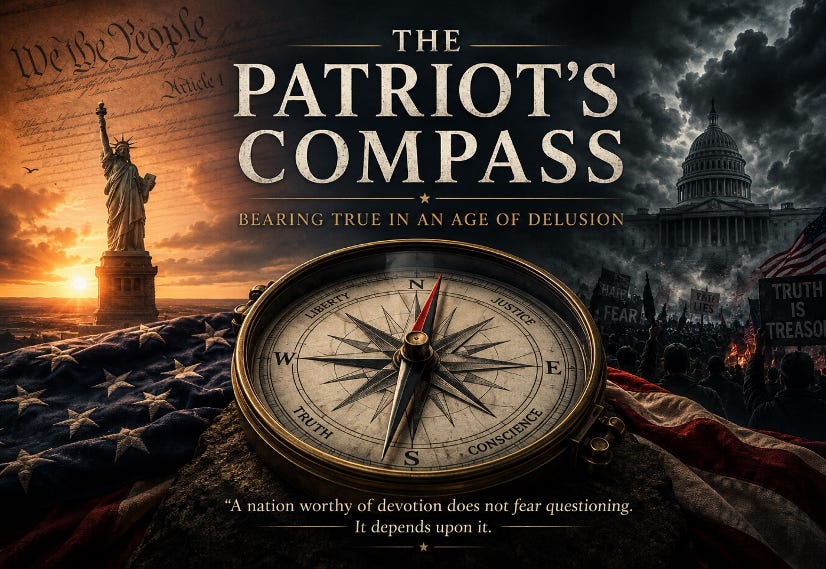
There are moments in history when familiar words deserve to be examined anew. Patriotism is one of them.
As our world grows more polarized, and nations once again edge toward the precipice of wider conflict, appeals to patriotism grow ever more urgent. Across the globe, flags are raised and slogans invoked to justify actions that bring humanity closer to catastrophe. In such an hour, a deeper reflection on what patriotism truly means—and what it does not—feels not only timely, but necessary.
Patriotism, in its purest sense, is a deeply personal bond between the human spirit and the ideals that make a nation worthy of devotion. Yet few concepts have been so thoroughly distorted, weaponized, or misunderstood. The reflections that follow represent the conclusions of a lifetime spent living under different flags, observing different systems of government, and asking what, ultimately, makes a nation worthy of our allegiance.
Although these reflections arise from my experience as an American citizen, the questions they explore are universal. Every nation has its flags, its myths, and its cherished narratives. I approach them through the lens of America because it is the country I know best—and the one to which I freely chose to give my allegiance.
The Blindfold of National Chauvinism
There is a primitive misconception that pledging unthinking allegiance to a piece of cloth, wrapped in an “America, right or wrong” bravado, constitutes love of country. In truth, this mindset misconstrues emotional impulse and inherited passion as civic virtue. It is an unexamined, reflexive process—the predictable byproduct of childhood indoctrination and shallow political rhetoric.
What does it truly mean to love one’s country? Is patriotism measured by the volume of our applause? By the size of the flag on our porch? By unquestioning loyalty to whichever administration happens to occupy the White House? Or does genuine patriotism demand something far more difficult: the courage to defend enduring principles, even when doing so requires standing against popular opinion?
A flag is a symbol. The Constitution is a standard.
One can salute the former while betraying the latter. Indeed, history offers no shortage of such examples. A true patriot does not outsource his conscience to political leaders, party platforms, or prevailing winds. He measures his country not by its rhetoric but by its adherence to its founding principles. He understands that fidelity to those principles may, at times, require dissent—because a nation is not weakened by honest scrutiny; it is strengthened by it.
The Crucible of Awakening
I was not born into America. I chose it. That distinction has always mattered to me because an immigrant embraces his nation through a deliberate act of will rather than by accident of birth. His commitment is a thoughtful, intentional act of judgment. His patriotism is not an unthinking inheritance but the earned consequence of conviction.
As a boy on the island then known as Ceylon, I fell in love with a country I had never seen. It was not the geography that captured me, but the idea—a daring experiment in human liberty, articulated in language so luminous that it seemed less a political document than a moral covenant. My mother unknowingly set that process in motion when she returned from the United States with a copy of Dale Carnegie’s Lincoln the Unknown and placed it in my hands. I was too young to appreciate the book’s significance, but something about Lincoln’s quiet moral courage lodged itself deep within me. By adolescence, I could recite the Gettysburg Address from memory, not because anyone required me to, but because those few immortal paragraphs had become something approaching a personal creed.
Even my professors in Scotland, where I studied aeronautical engineering and trained as a commercial pilot, found my affection for America mildly amusing and nicknamed me “Yank.”
They were right.
Long before I carried an American passport, I already considered myself an American in spirit. America represented a promise: courage, liberty, individual responsibility, and the intoxicating possibility that a man might rise by character rather than by pedigree.
The Education No University Offers
Like many young idealists, I initially confused love of country with trust in government. The distinction would take decades to understand.
My political awakening did not arrive overnight; it emerged gradually through books, friendships, and painful reflection. Howard Zinn’s A People’s History of the United States invited readers to examine familiar history from unfamiliar angles, challenging many of the assumptions I had inherited without ever questioning them. William Blum’s Rogue State soon joined that growing list of indispensable books, and I later had the privilege of counting Bill among my friends. John Perkins’ Confessions of an Economic Hitman forced me to re-examine even more assumptions I had scarcely realized I held.
Most influential of all was the late Dr. Robert Bowman, a retired U.S. Air Force lieutenant colonel. Bob was no armchair critic; he flew more than one hundred combat missions over Vietnam in F-105s before earning dual doctorates from Caltech in aeronautics and nuclear engineering. He then rose to become Director of Advanced Space Programs Development for the U.S. Air Force and later served as Director of President Ronald Reagan’s Strategic Defense Initiative, the famous “Star Wars” program. Few men possessed a deeper understanding of both military power and the machinery of government. Years later, when Bob sought the Reform Party nomination for President of the United States, he asked me to serve as his aide-de-camp during his campaign. Bob became far more than a mentor; he became something of a surrogate father.
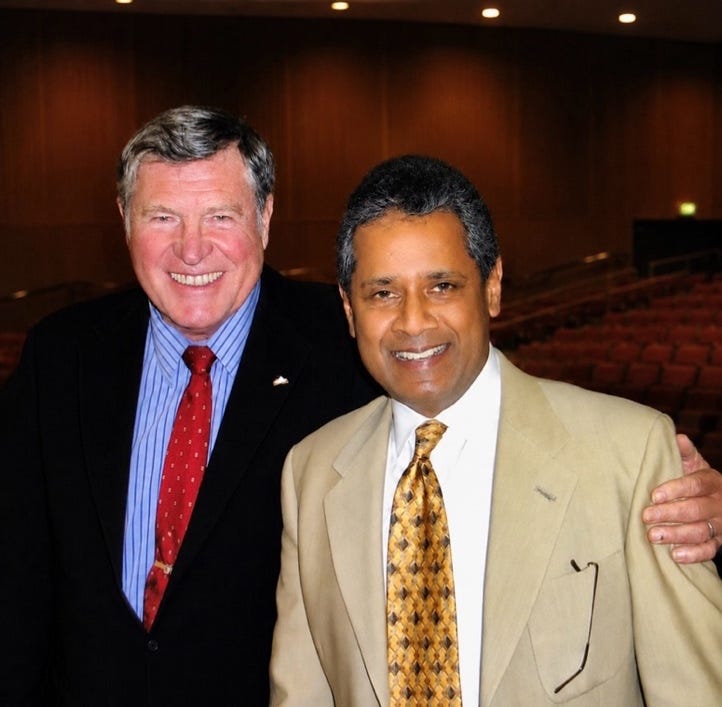
With Dr. Robert M. Bowman, former Director of the U.S. Air Force’s Advanced Space Programs Development and of President Ronald Reagan’s Strategic Defense Initiative (“Star Wars”), during his 2004 presidential campaign. Tallahassee, Florida.
From these and other remarkable men, I learned a lesson that, once grasped, is impossible to unlearn: governments and nations are not the same. A populace is not its leadership. A Constitution is not those temporarily entrusted with administering it. Gradually, I came to realize that my allegiance had never belonged to presidents, political parties, intelligence agencies, or military adventures—nor, ultimately, even to the flag itself. Flags are magnificent symbols, but they remain symbols; the ideals they represent are what truly matter.
My allegiance belonged to the extraordinary ideas that flag was intended to represent: individual liberty, limited government, due process, free speech, freedom of conscience, and equal justice under law.
Those principles remain worthy of reverence regardless of which political faction occupies Washington.
Many people confuse patriotism with agreement. I have come to believe almost the opposite. Theodore Roosevelt drew precisely this distinction when he observed that insisting there be no criticism of the President, or that we must stand by the President, right or wrong, “is not only unpatriotic and servile, but morally treasonable to the American public.”
Blind loyalty requires remarkably little thought; genuine patriotism demands constant vigilance. It asks difficult questions, scrutinizes those entrusted with power, and refuses to excuse injustice simply because it wears one’s own national colors.
The Infinite Perspective
Over time, the lens through which I viewed the world widened in ways I could never have anticipated as a young man. It began with a question that has captivated humanity since our ancestors first looked skyward: Are we alone in the universe?
That inquiry occupied me for much of my adult life. Decades spent investigating the evidence gradually transformed not only my understanding of the phenomenon itself, but also my perspective on humanity. Whether readers ultimately agree with the conclusions I reached is almost beside the point. What mattered was not merely the destination, but the person the journey made of me. When we begin contemplating intelligent life on a cosmic scale, many of our earthly obsessions begin to look strangely provincial. Borders, flags, ethnic rivalries, religious hatreds, and territorial disputes reveal themselves as deeply temporary arrangements—forged in conflict and preserved merely by habit. They remain intensely important to those living within them, of course. Yet from a broader historical—and perhaps even cosmic—vantage point, they begin to resemble transient constructs rather than eternal truths.
History confirms this with striking consistency.
So many modern nations occupy land whose boundaries history redrew in the blink of an eye. Not so long ago, California and Texas belonged to Mexico—yet today, Mexicans crossing those same borders are branded as invaders. Königsberg—the Prussian city that nurtured Immanuel Kant for nearly eighty years—became Soviet Kaliningrad almost overnight. For centuries, Alsace-Lorraine swung like a tragic pendulum between France and Germany, its citizens forced to switch allegiances—and flags—with every passing war.
Much of the modern Arab Middle East owes its political geography not to ancient civilizations but to two diplomats—Mark Sykes and François Georges-Picot—who sat in a quiet room in 1916 and drew arbitrary lines across a map. Before that secret agreement, Jordan, Iraq, Syria, and Lebanon did not exist; they were merely administrative provinces of the Ottoman Empire. With a stroke of a foreign pen, the Sykes-Picot line severed ancient tribal lands and cultures overnight, creating synthetic states, each with its own national identity and symbols, designed to serve imperial oil interests.
It also bears remembering that Israel itself did not exist until 1948, emerging from much of that same colonial machinery. Thirty-one years earlier, a short, typed letter—the “Balfour Declaration”—had laid the groundwork, transforming a British promise into a foundational instrument of statehood on land known for centuries as Palestine. Decades later, that same imperial logic played out again. In 1967, Israel seized the Golan Heights from Syria; in 1981, it formally extended Israeli law and administration over Syrian territory, treating it as sovereign Israeli land. A nation whose modern statehood began with a foreign declaration had itself come to assert sovereignty over territory acquired by war.
History is written entirely by the victors, and borders are no more than fleeting lines drawn in the sand by temporary conquerors. What tragedy that millions have offered the ultimate sacrifice for boundaries that didn’t exist yesterday—pledging sacred, unquestioning “patriotism” to ink marks on a map and a temporary piece of cloth, as though they had existed since the dawn of time.
That realization did not diminish my affection for America; it deepened it. It reminded me that the values worthy of our deepest allegiance are those that can survive the rise and fall of nations. Liberty, justice, compassion, and human dignity belong to no single country; they are humanity’s inheritance.
And that recognition quietly altered the way I thought about patriotism.
A Wider Circle
As the years passed, these reflections gradually took on a spiritual dimension and eventually found expression in my book Warpaint of the Gods. I recognize that not every reader will share my conclusions, nor do I expect them to; each of us approaches life’s deepest questions along different paths. Nor is this perspective either novel or merely a product of imagination. When we look beneath centuries of interpretation and doctrine, recurring themes emerge across many traditions—from ancient Vedic writings and the poetic depths of the Qur’an to early Christian texts and the Buddhist Dhammapada. While these traditions differ in language and emphasis, many speak, in their own ways, to a process of moral growth, accountability, and renewal—sometimes described as a gradual purification of the soul.
Even within the quiet, mysterious passages of the Gospels, Jesus’ more enigmatic sayings have been interpreted as suggesting a continuity of the soul that extends beyond a single lifetime. Over time, I came to see human existence not as a single, self-contained episode but as part of a larger continuum. Whether one understands this through the idea of reincarnation, a broader spiritual continuity, or simply the enduring law of cause and effect, the ethical implication remains the same: our lives are deeply and inextricably connected.
How many banners might we have saluted across the sweep of history? How many languages spoken, how many faiths embraced with full conviction? How many borders defended with our lives, only to be redrawn or forgotten by the generations that followed? General George S. Patton, who often spoke of having lived before, captured this sense of continuity when he wrote, “So as through a glass and darkly, the age-long strife I see, where I fought in many guises, many names, but always me.”
These reflections are not meant to diminish love of country, but to broaden our understanding of one another. If we were to see the roles we occupy—nationality, race, class, and creed—as temporary rather than permanent, how might that change the way we treat one another? Would hostility hold the same power if we viewed those we oppose not as permanent adversaries, but as fellow participants in a shared human journey? Would war retain its aura of glory, or come to seem a tragic failure of vision?
The older I grow, the more convinced I become that humanity spends enormous energy defending labels while overlooking the deeper unity that binds us. Even setting aside any spiritual framework, one principle remains clear and accessible to all: our actions carry consequences that extend far beyond ourselves. A society that forgets this—one that elevates power above principle or loyalty above truth—does so at its own peril.
The Ultimate Allegiance
Which brings me back to where this reflection began.
I remain profoundly grateful to America. I arrived in this country as an immigrant more than half a century ago. After an unfortunate theft in New York, I found myself with little more than a backpack, five dollars, and a head full of improbable dreams. Yet America rewarded hard work, opening doors I could scarcely have imagined as a boy growing up in Ceylon. It gave me the chance to build a home, to become a husband and a father, and to form friendships I will cherish for the rest of my days.
Precisely because of that gratitude, I cannot remain silent when I see the nation drifting away from the principles that first drew me here.
Silence is not patriotism; it is acquiescence.
I did not come to this country to worship it. I came to honor its promises—and to hold both it and myself accountable to them. True patriotism, in its highest sense, is neither hatred of the foreigner nor blind obedience to the state. It is a steadfast commitment to a nation’s highest ideals: liberty, justice, the rule of law, and the elevation of human dignity.
As I enter the autumn of my life, my understanding of patriotism has become remarkably simple.
A patriot is not someone who believes his country is incapable of wrongdoing. Rather, a true patriot is someone who loves his country enough to insist that it live up to its own promises.
He measures governments against the Constitution—not the Constitution against governments.
He understands that loyalty to enduring principles must always outrank loyalty to temporary politicians, and that every oath ultimately belongs to truth, justice, and conscience.
A nation worthy of devotion does not demand blind conformity from its citizens. It welcomes the critical eye, knowing that true strength lies in its capacity for self-correction.
Politics divides; principles unite.
Governments will continue to change. Political parties will rise and fall. Presidents will come and go. Even great powers, history assures us, are temporary. Principles endure.
That, to me, is the compass by which patriotism must always steer.
So when I am told that questioning my country’s actions is unpatriotic, I can only smile. It is the quiet, knowing smile of someone who has lived long enough to witness empires falter under the weight of their own unquestioned hubris.
My loyalty has never been to the illusion of perfection, but to the pursuit of it.
A nation worthy of devotion does not fear such loyalty.
Its very future depends upon it.
