One unanswered question rarely overturns a worldview.
Human psychology has an extraordinary capacity to preserve its own peace. When an event runs counter to what we expect, or when a piece of evidence refuses to fit the accepted explanation of the day, we do not immediately dismantle our understanding of society. We do what almost anyone does: place the troublesome fact on a mental shelf, tell ourselves there is probably an innocent explanation we have yet to grasp, and carry on with our lives.
My difficulty with September 11 was that the questions refused to stay on the shelf.
They multiplied.
The physical behavior of the Twin Towers that morning was merely the first fracture. As I recounted in my last dispatch, I watched those massive steel-framed structures survive violent aircraft impacts—remaining upright and structurally intact, precisely as their architect, Minoru Yamasaki, had said they were engineered to do—only to see them, minutes later, disappear amid enormous clouds of pulverized concrete and steel fragments. What I witnessed created immediate, irreconcilable friction with my engineering background.
Yet an isolated question, even a serious one, can be set aside. What followed over the next quarter-century was far harder to ignore. Once I began examining the physical record, anomalies surfaced not only in disciplines I knew by trade—structural mechanics, aerodynamics, flight operations—but also in specialized fields where I had to seek out professionals whose technical expertise far exceeded my own.
When One Question Becomes Many
An anomaly in isolation proves very little.
Every complex event in human history comes wrapped in a haze of confusion: panicked witnesses, conflicting early reports, bureaucratic blunders, and unresolved fragments of evidence. If an inquiry seized on every stray inconsistency as proof of grand deception, it would succumb to the very reflexive thinking we spent the early weeks of this series learning to recognize.
But there comes a point when isolated anomalies begin to form a pattern.
Much of my professional life was spent in cockpits and engineering environments, where diagnosing complex systems is an everyday necessity. In aviation, when a single instrument reads abnormally, your first duty is to cross-check the instrument itself. Sensors malfunction; gauges drift; circuits short. You don’t panic.
But when independent instruments—fed by separate systems, drawing from separate sensors, measuring entirely different physical parameters—begin to point to the same underlying failure, you stop blaming the gauges.
You investigate the aircraft.
That distinction became the spine of my inquiry.
Two Airplanes Crash—Three Skyscrapers Collapse
Consider the buildings themselves.
In my previous column, I spoke of the Twin Towers—their robust structural steel matrices, their perimeter-tube design, and the perplexing speed, symmetry, and completeness with which they ultimately disintegrated downward, through the path of greatest structural resistance.
Then came World Trade Center 7.
To this day, an astonishing number of otherwise well-informed people remain unaware that a third massive skyscraper collapsed in Lower Manhattan that afternoon. It was a 47-story steel-framed high-rise that occupied an entire city block.
No aircraft struck it.
Yet at 5:20 that evening, Building 7 suddenly descended into its own footprint, collapsing with extraordinary symmetry into a compact pile of rubble in less than seven seconds. The collapse looked indistinguishable from a textbook-controlled demolition.
I watched news footage of that collapse on the evening of September 11. In the days that followed, however, Building 7 all but disappeared from television coverage—and, with it, from public consciousness.
Until that day, no steel-framed skyscraper in the entire history of construction engineering had ever been known to collapse completely from fire. On 9/11, we were asked to accept that three had done so. All in a single afternoon. And one had never even been struck by an airplane.
Whatever technical conclusions one ultimately reaches, my questions could no longer be confined to what had happened to the Twin Towers.
The Voices from the Basement
Then there was Willy.
In my last column, you met William Rodriguez, the maintenance worker who held the master key to the North Tower, saved countless lives, and was officially honored at the White House as a national hero. You also heard what he reported experiencing: a massive concussive explosion deep in the Tower’s sub-basement levels before the aircraft’s impact high above—an explosion so violent that it threw him upward, ripped doors from their hinges, and severely burned workers on the lower levels.
Willy was not an Internet theorist. He was an eyewitness standing at ground zero of modern American history.
Nor, I discovered, was his account unique. In the years that followed, as I joined colleagues at Architects & Engineers for 9/11 Truth and worked through thousands of pages of documentation,
I encountered numerous recorded statements from firefighters, police officers, and medical first responders describing distinct secondary concussions and explosions throughout the complex’s lower levels.
This raised a question that went straight to the heart of everything we had spent the preceding weeks examining: What happens when direct eyewitness testimony refuses to fit the story ultimately constructed around an event?
Were all these first responders simply disoriented? If so, were their observations rigorously investigated, or were they quietly left off the ledger? When the final history was codified in the 567 pages of the 9/11 Commission Report, Willy Rodriguez’s testimony was omitted entirely. The testimony itself remained classified and effectively disappeared from the public record.
The Aviation Paradox
As a former pilot who spent years flying through the harsh and unforgiving weather of Alaska’s North Slope, I found other aspects of the official account presented problems of an entirely different kind.
Consider the flight profile attributed to the aircraft that struck the Pentagon.
We are asked to accept that a heavy commercial airliner—a Boeing 757 traveling at extreme speed near sea level in dense, turbulent air—was flown through an intricate descending 330-degree turn, then leveled out just feet above the ground before striking the ground floor of a reinforced structure without its wing-mounted engines gouging the lawn.
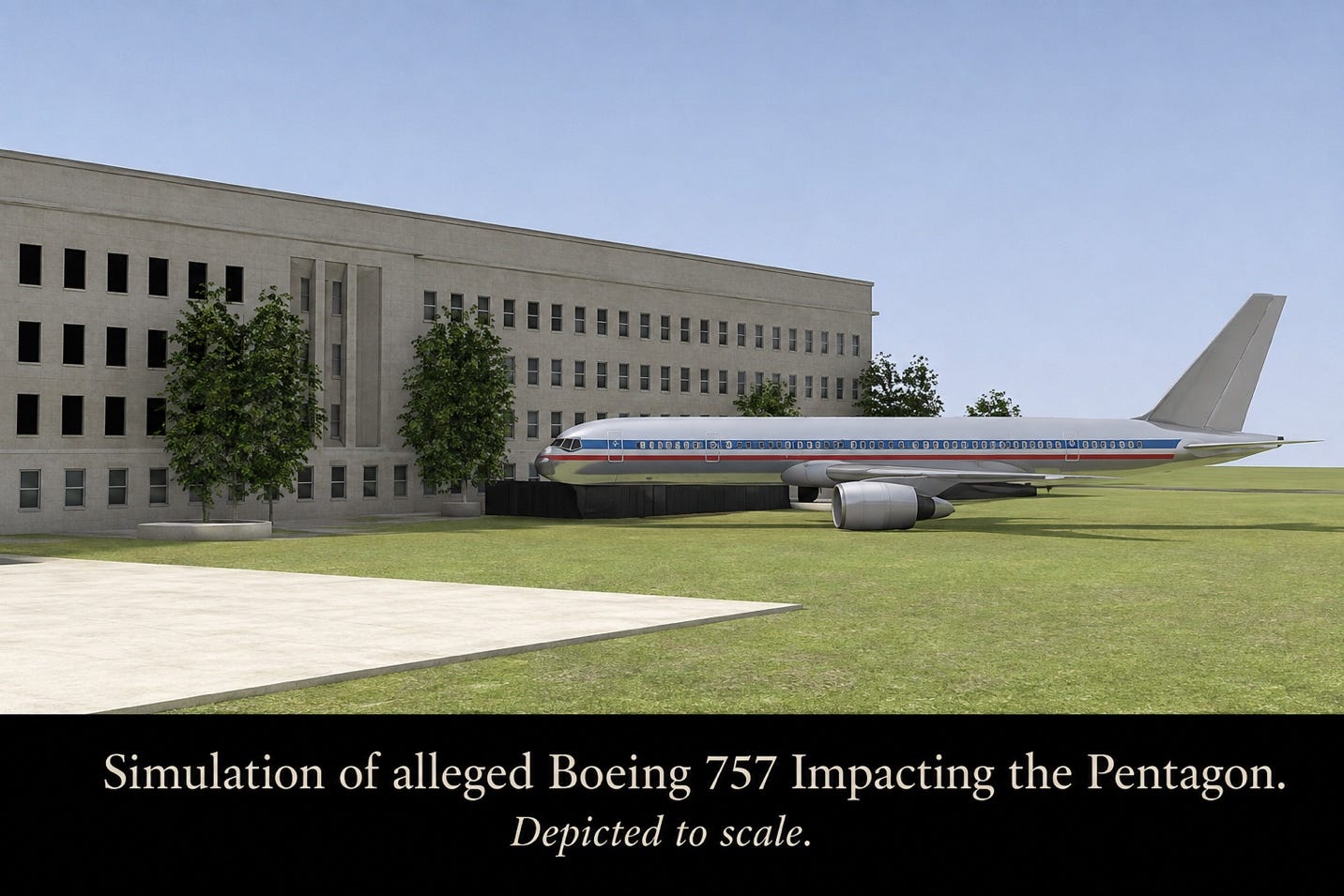
Executing such a trajectory at high speed demands extraordinary stick-and-rudder finesse, precise energy management, and intimate familiarity with high-speed aerodynamic control. Yet the final, ground-hugging approach at that velocity troubled me most. Ground effect was not merely an aerodynamic principle I had studied in college; it was a phenomenon I had experienced countless times from the cockpit. I understood it both in theory and in practice. Based on that combination of engineering knowledge and practical flying experience, I found the maneuver practically impossible.
And the individual officially credited with that feat, Hani Hanjour, reportedly struggled during basic flight training in a small, single-engine Cessna. His instructors described his flying abilities in remarkably unflattering terms, with one flatly stating that the man simply “could not fly at all.”
Every experienced pilot understands the unforgiving realities of control feel, air density, inertia, and energy management. When a maneuver that would severely test an accomplished aviator is attributed to someone who couldn’t even fly a light trainer proficiently, an aviator’s mind cannot simply shrug and move on.
During this period of inquiry, I encountered a man whose credentials to address precisely these questions were impossible to dismiss: a veteran fighter pilot with 101 combat missions in supersonic F-105s over Vietnam, an aerospace engineer with a doctorate from Caltech, and a former Director of Advanced Space Programs Development for the United States Air Force.
His conclusions about September 11 were every bit as sobering as my own.
When the Investigation Raises Questions
At a certain point, my research underwent a decisive shift. The central question was no longer merely: What happened on September 11?
Another had begun demanding equal attention:
How was September 11 investigated?
Here, the cognitive groundwork we built together during the opening weeks of this series comes into sharp focus. An investigation does more than gather evidence. It decides what to examine, how to weigh competing evidence, which questions merit pursuit, and ultimately what enters the historical record.
As I examined the 9/11 Commission and the broader investigative process, questions accumulated there as well:
· Why was the structural steel from the largest building collapse in modern history rapidly cut up, loaded onto barges, and shipped overseas for scrap without a comprehensive forensic examination?
· Why were the extraordinary financial anomalies—including twentyfold spikes in put options on the airlines that were later caught up in the attacks—dismissed without a satisfactory public accounting?
· And, most fundamentally, were competing hypotheses genuinely tested against the physical evidence, or was the investigation conducted within the boundaries of an already accepted explanation?
Eventually, the conduct of the investigation itself became part of what I believed needed to be investigated.
The Problem of Convergence
And here we reach the heart of the matter.
A structural anomaly, considered in isolation, might be attributed to an unprecedented thermal phenomenon. An eyewitness account might be dismissed as the product of trauma, confusion, or smoke inhalation. An aviation anomaly might be written off as an extraordinary stroke of beginner’s luck. An investigative omission might be blamed on bureaucratic incompetence.
My own turning point came when questions arising independently across entirely different disciplines began pointing in the same troubling direction.
I was no longer confronting a single troublesome fact. I was confronting an entire constellation.
I am not suggesting that the existence of these anomalies, by itself, provides us with a neat alternative account of what happened that day. Real skepticism cannot consist merely in exchanging one ready-made dogma for another. My argument is simpler—and considerably more demanding:
At some point, the sheer weight, independence, and variety of unresolved anomalies make continued inquiry an unavoidable intellectual duty.
The Man Who Challenged Empire
Among the many extraordinary professionals this journey brought into my life—architects, physicists, metallurgists, firefighters, intelligence analysts, and fellow aviators—only one man eventually stood apart.
Not merely because of his formidable qualifications, but because of what he was prepared to sacrifice by speaking openly about his beliefs.
His name was Dr. Robert M. Bowman.
Bob had flown more than a hundred combat missions, held doctorates in aerospace and nuclear engineering, and served as Director of Advanced Space Programs Development for the U.S. Air Force. He understood the intersection of military technology, national-security policy, and state power from a vantage point few of us could ever hope to reach.
And he was unafraid to challenge it.
For the past several months, I have been working to tell Bob’s story. Next week, on the twenty-fifth anniversary of September 11, I will finally release the documentary honoring his legacy: The Man Who Challenged Empire. It is also my invitation to you to examine some of the evidence that changed the course of my own life—and to hear the voice of an extraordinary man who possessed both the credentials and the courage to challenge the most powerful institutions of his time. I hope you will watch it.
Twenty-five years ago, a single question crossed my mind as I watched those towers turn to ash.
It did not remain one question.
It became a relentless cascade: structural questions, aviation questions, eyewitness questions, investigative questions, and ultimately questions about the institutions we trust to define our shared reality.
In the weeks ahead, we will take some of those questions apart together, piece by piece, under the clear light of physical law and documentary evidence. You may examine what I present and decide that I am correct. You may decide that I am entirely mistaken.
I ask only what this discipline has demanded of us from the beginning:
Do not look away.

The Rogue Philosopher columns appear weekly on Substack in a numbered sequence
to preserve the continuity of the intellectual journey.