

The Day the Questions Began
A Personal Journey into September 11
There are moments in life when something you are watching refuses to fit inside what you already know. For me, one of those moments came on the morning of September 11, 2001.
But the story really began many years earlier.
I was seven when my mother visited America and sent me a postcard photograph of herself standing atop the Empire State Building. I remember staring at that impossible structure and wondering how human beings could build something so enormous and send it so far into the sky.
Skyscrapers fascinated me from then on. Perhaps there was something genetic about it. Five members of my extended family were architects—three uncles and two cousins—and one of those uncles, who designed Ceylon’s first planetarium, greatly admired the work of Minoru Yamasaki, the architect of New York’s World Trade Center.
Years later, while working in Alaska, I briefly maintained an apartment in Manhattan with a girlfriend. On one winter visit, I heard about the new restaurant high atop the North Tower, Windows on the World, and naturally had to see it. So we made dinner the highlight of our first visit.
Our table sat against an expansive plate-glass wall overlooking Manhattan. But on that winter night decades ago, at nearly fifteen hundred feet, Manhattan vanished entirely beneath us. In its place stretched an endless, luminous carpet of puffy white clouds, rolling away in every direction to the limits of vision. The cloud tops were bathed in moonlight and, closer at hand, in the warm amber glow spilling from the illuminated restaurant behind us. It was otherworldly—a vision of engineering suspended in the heavens. Magical… a sight I have never witnessed again, and never will.
I later watched an archival interview with Yamasaki. Asked about the possibility of an accidental aircraft collision in dense fog, his response was unequivocal: the towers were structurally engineered to withstand the impact of a fully loaded Boeing 707—the largest airliner of its era. In fact, Yamasaki noted the robust perimeter-tube design could withstand impacts by multiple 707s. I was hugely impressed.
Years passed. As an aeronautical engineer, structural mechanics ceased to be something I merely admired from a distance. It became part of the way I understood the physical world.
Then came that September morning.
Watching from California
On September 11, 2001, watching the events unfold live from California, I immediately felt my engineering instincts surface. When the aircraft struck, both towers remained solidly erect. They did not shear; they did not topple; they stood firm, venting thick, dark smoke.
They were still standing.
I remember, bizarre as it may sound now, feeling a fleeting admiration for the structural achievement I was witnessing. The buildings had taken two appalling blows and remained standing.
While the Boeing 767s that struck the towers were roughly eighteen percent heavier than Yamasaki’s 707s, the 707 had a higher cruising speed. That distinction matters. Basic Newtonian physics dictates that kinetic energy is proportional to mass and to the square of velocity. The 707’s higher speed made the kinetic energy of both aircraft broadly comparable. Watching both towers absorb those massive initial impacts and remain standing, I felt I was witnessing real-world validation of Yamasaki’s genius.
But my amazement was short-lived.
Minutes later, the South Tower erupted into an enormous, almost volcanic cloud of billowing dust—and collapsed.
The North Tower followed the same pattern.
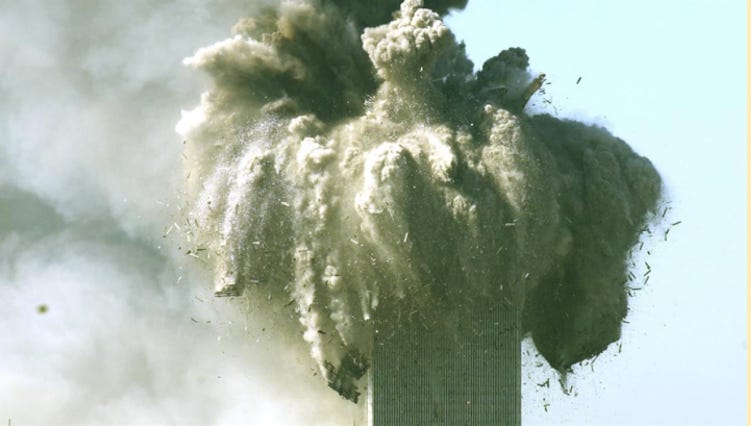
The physics simply did not add up. How could massive skyscrapers made of structural steel and reinforced concrete suddenly pulverize into ash in mere seconds?
And once that thought entered, it never left.
That morning marked the start of an investigation that has, almost obsessively, occupied me for twenty-five years.
Then I Met Willy—“The Last Man Out”
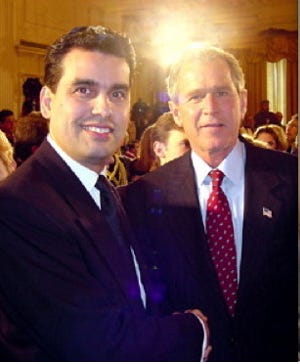
William Rodriguez receiving the National Hero Award at the White House
Three years later, my journey took an unexpected turn when I met William “Willy” Rodriguez. And my technical deductions found dramatic human corroboration.
A former Puerto Rican law student turned maintenance worker, Willy spent twenty years at the World Trade Center. He held the master key to the North Tower’s stairwells—the only key in existence that granted access to all 110 floors.
Willy’s bravery that morning was extraordinary. He led FDNY crews up the stairwells, unlocked exit doors, manually pried open elevator doors to rescue trapped occupants from the shafts, and personally carried several severely injured workers out of the complex. He re-entered the building three times to rescue others, ultimately becoming the last survivor to escape the North Tower.
Yet what Willy carried out of the wreckage was more than the story of his heroism. He carried an eyewitness account that would later disappear almost entirely from the official public narrative.
The Explosions in the Basement
Rodriguez was stationed in the basement on sub-level 1 when massive explosions occurred on sub-level 2—a restricted-access mechanical floor directly below him. One blast was so powerful it literally threw Rodriguez upward, off the floor, as parts of the false ceiling collapsed onto and around him.
Crucially, the explosions below and the airplane impact high above were two distinct, unmistakable events separated in time. Rodriguez and his colleagues felt multiple detonations beneath their feet a full seven to eight seconds before the first plane struck the tower. Only after the basement had already sustained heavy damage did the aircraft impact register as a second, separate shockwave throughout the building.
Felipe David, a fellow worker who was working at the far end of Basement Level 1, across from Rodriguez, fell victim to the second explosion. David was walking toward a supply room when the entire wall suddenly exploded in front of him. Burned beyond recognition, David managed to stagger toward Rodriguez, and when Willy took one look at the man, he froze.
The skin on his face had almost completely peeled away, exposing “raw, pink flesh,” and the burnt skin of his outstretched arms was hanging horrifically “like sheets of loose cloth.”
David was the first casualty whose life Rodriguez saved by carrying him up to paramedics at street level. Afterward, he returned to the basement, defying police orders. He finally escaped shortly before the North Tower came down and survived the collapse by diving under a fire truck, where he lay buried in dust and debris for hours.
For his actions that day, he was honored at the White House, where President George Bush Jr. presented him with a “National Hero Award.”
Evidence Scrubbed
Rodriguez presented this critical timeline of the early explosions to the 9/11 Commission behind closed doors—complete with corroborating eyewitnesses and testimony about secondary explosions echoing throughout the building. His evidence was scrubbed. Not a single sentence of his sworn testimony appeared in the 600-page 9/11 Commission Report. His official deposition was stamped “Restricted.”
I listened to Willy very carefully because this was no anonymous voice on the Internet. This was a man sitting before me, someone I came to know personally—a man who had spent nearly two decades working inside that building and whose courage on September 11 had already been publicly celebrated.
And his story raised a question I could not dismiss.
If his and his colleagues’ recollection of the timing was accurate, what exactly happened on the level below him? Rodriguez, now a mini-national celebrity, began publicly asking questions about the explosions.
The Cost of Conscience
Willy, who had political aspirations, was soon presented with an ultimatum: toe the line, accept lucrative political backing as an establishment hero, and bury his questions—or become a pariah. He chose his conscience:
“I had to choose whether to tell the truth or play their game. I couldn’t get myself to play their game.”
The consequences were swift. Official support evaporated. The mainstream press imposed a total blackout on his firsthand accounts of basement detonations. Other key witnesses who reported secondary explosions—including NYC Emergency Coordinator Barry Jennings—died under highly suspicious circumstances.
Testimony does not become unworthy of examination merely because its implications are inconvenient.
That principle is precisely what these past twelve columns have been preparing us to understand. We must ask what was actually observed, what was subsequently inferred, what evidence supports or contradicts the testimony, and—perhaps most importantly—what found its way into the official narrative and what was left out.
Those questions require no conspiracy theory. They require curiosity.
The Man Behind the Testimony
When I first met Willy in 2004, I found him charismatic, intelligent, articulate, and full of an infectious energy. Through him, I subsequently became involved with an international group examining the events of September 11. Our circle included engineers, architects, pilots, firefighters, scientists, lawyers, and others, and over the following months, many of us became close friends. As the movement grew, many of these professional communities formed organizations of their own—Architects & Engineers for 9/11 Truth, Pilots for 9/11 Truth, Firefighters for 9/11 Truth, Lawyers for 9/11 Truth, and Scientific Panel Investigating Nine-Eleven among them—each bringing the tools and experience of its particular discipline to bear on the evidence.
That experience changed the nature of my inquiry.
I was no longer sitting alone with calculations and television footage. I was meeting people who had been there, listening to first responders and survivors, comparing their recollections, and applying my background in aviation and engineering to questions that increasingly troubled me.
Some of those questions will be addressed in future columns. They deserve room.
September 11 is too consequential, too emotionally charged, and too deeply embedded in the history of the twenty-first century to be treated as a grab bag of anomalies. If we are going to examine it, we owe the dead—and ourselves—something more disciplined.
We must take the evidence piece by piece.
Twenty-Five Years Later
A quarter-century has passed since I sat before a television in California and watched two buildings I had once admired disappear from the Manhattan skyline.
I can still remember that postcard from my mother. I can still remember the luminous clouds beneath Windows on the World. I can still remember Minoru Yamasaki’s words returning to me as the towers stood after the impacts:
“They are designed to withstand multiple impacts by Boeing 707s.”
And I can still remember the bewilderment that followed when they came down.
Twenty-five years of inquiry have not diminished the importance of the questions that began for me that morning. They have made the obligation to ask them even more serious.
Operation Northwoods, which we examined last week, taught us something uncomfortable about precedent: sometimes history places the blueprint itself in our hands. With September 11, no comparable operational blueprint has entered the public record. What we do have is a far more complex mosaic—physical evidence, engineering, physics, eyewitness testimony, official investigations and their omissions, and documents and testimony that illuminate the strategic ambitions surrounding the event and the geopolitical consequences that followed.
September 11 therefore demands a different kind of inquiry: one in which we assemble those pieces patiently, examine each on its own merits, and resist deciding in advance what picture they are permitted to form.
I shall not ask you to believe what I believe.
I ask something harder.
Come with me and look.
